SOC 2 Type I vs Type II: Which Do Investors and Enterprise Buyers Actually Want?
Published
September 17, 2026

You’ve done the hard work—built a strong product, secured a promising lead, and finally made it into the room with enterprise buyers or investors. Then the momentum suddenly slows with one question: Do you have a SOC 2 report? Is it Type I or Type II? At that moment, everything depends on a detail many founders don’t fully understand.
The gap between SOC 2 Type I and Type II is more than just a compliance checkbox.It can be the reason you close a deal quickly, face a long due diligence process, or even lose trust. Understanding your SOC 2 readiness can help you choose the right path before investing time and resources. This guide explains the differences, defines what investors and enterprise buyers are looking for, and helps you decide which option is best for your business.
SOC2 is an independent audit that checks if your organization has the right controls in place to protect customer data. Both SOC 2 Type I and SOC 2 Type II assess your security program, but they focus on different aspects.
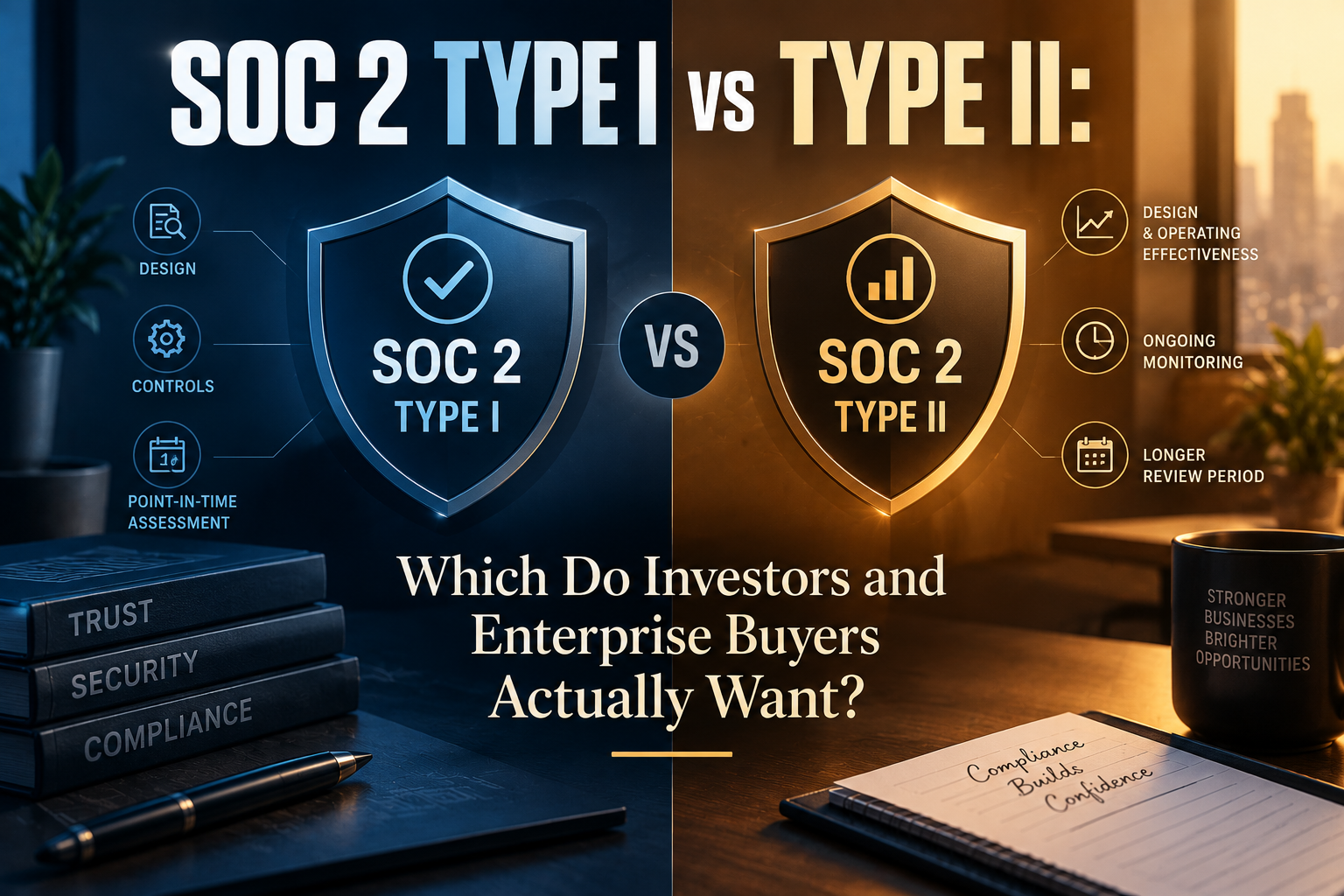
● SOC2 Type I checks whether your security controls are properly designed and implemented at a specific point in time.
● SOC2 Type II evaluates both the design of controls and their operating effectiveness over a defined period.
If your goal is... Recommended Report
Launch a new security program Type I
Meet early customer security requests Type I
Sell to large enterprises Type II
Support investor due diligence with stronger operational evidence Type II
Build long-term trust with regulated customers Type II
The key isn't choosing the "better" report. It's about choosing the report that aligns with your current business objectives and customer expectations.
A SOC2 Type I report examines whether your organization's security controls are appropriately designed and implemented on a specific assessment date.
An independent CPA firm reviews your setup to determine whether your controls meet the required Trust Services Criteria.
In other words, the examination answers questions such as:
● Have appropriate access controls been implemented?
● Are security policies documented?
● Are incident response procedures established?
● Are employee onboarding and offboarding processes defined?
● Is sensitive customer data protected through documented controls?
If the answer is yes, those controls can be evaluated as suitably designed.
A Type I report shows that your organization has taken meaningful steps toward building a structured security and compliance program.
It demonstrates that:
● Security controls exist.
● Policies have been officially recorded.
● Governance processes have been set up.
● Management is aware of compliance duties.
● Your company is dedicated to protecting customer data.
If you’re an early-stage SaaS company trying to break into enterprise sales, this kind of report can give you a real credibility boost. It’s often what gets youin the door and helps speed things up.
This is where many companies misunderstand the value of Type I.
A Type I report does not demonstrate that your controls have been operating consistently over time.
For example:
Your company may have implemented quarterly access reviews.
A Type I examination can confirm that this control exists.
It cannot show that those reviews have actually been done every quarter.
Similarly:
● Password policies may be documented.
● Incident response procedures may be written.
● Vendor management processes may exist.
But Type I doesn’t show whether these activities have been done regularly in daily operations.
For that evidence, a Type II examination is needed.
SOC2 Type I can be a good choice when:
● Your company recentlyformalized its security program.
● You're preparing for your first SOC2 examination.
● You need initial assurancefor prospective customers.
● You're building toward a future Type II report.
● You haven't yet accumulated enough operating history for a Type II examination.
For many startups, Type I is the first step in a bigger compliance process, not the final goal.
A SOC2 Type II report goes a significant step further.
Rather than evaluating your controls at a single point in time, it examines whether those controls operated effectively over a defined review period.
This observation period may span several months, allowing the auditor to determine whether your security program functions consistently in real-world operations.
Instead of asking, "Did these controls exist on one particular day?"
Type II asks, "Have these controls been working well throughout the review period?"
That difference is exactly why enterprise procurement teams place greater confidence in Type II reports.
Auditors will usually review the following recurring evidence as part of the review of operating effectiveness:
● User access reviews
● Employee onboarding and offboarding records
● Incident response documentation
● Change management activities
● Vulnerability management processes
● Security monitoring logs
● Vendor risk assessments
● Backup and recovery testing
● Management reviews
● Policy acknowledgements
The examination seeks to identify evidence of consistent performance of these activities rather than a piece of documentation.
Enterprise buyers rarely worry about whether a company can write security policies.
They're trying to understand whether those policies are followed on a weekly, monthly,and quarterly basis.
Suppose that you're comparing two software companies.
Vendor A provides a Type I report showing excellent security documentation.
Vendor B provides a Type II report demonstrating months of successful access reviews,continuous monitoring, incident response testing, and ongoing control execution.
Which vendor would inspire greater confidence?
For most procurement teams, the answer is clear.
A Type II report reduces uncertainty by showing that security is not just planned but is part of your daily business operations.
This extra layer of security is crucial when vendors handle sensitive client data or support core business operations.
Both reports assess security controls, but they address different businessquestions.
Factor SOC 2 Type I SOC 2 Type II
Assessment focus Control design and implementation Control design plus operating effectiveness
Assessment timing Specific point in time Defined review period
Evidence depth Snapshot of implemented controls Repeated operational evidence collected over time
Time to Complete Faster Longer due to observation period
Buyer confidence Demonstrates initial readiness Demonstrates consistency, maturity, and reliability.
Best fit Early-stage companies or newly established compliance programs Mature security programs pursuing enterprise customers
Commercial strength Useful first milestone Stronger signal for enterprise procurement and long-term growth
The comparison makes one thing clear: Type I shows that your security foundation exists. Type II proves that the foundation holds up under day-to-day operations.
Enterprise procurement teams are responsible for reducing vendor risk—not simply checking a compliance box.
When evaluating technology vendors, enterprise buyers want proof that security controls are consistently followed in practice, making SOC 2 Type II reports preferred as they demonstrate adherence over time.
However,that doesn't mean every enterprise customer automatically rejects a Type I report.
Acceptance often depends on factors such as:
● The sensitivity of the datayour product handles
● The size and value of thecontract
● Whether your solution isbusiness-critical
● The buyer's internalsecurity policies
● The maturity of youroverall security program
Takeaway: Do not assume what yourbuyers need. Ask buyers about security expectations early in the sales processto avoid delays, streamline procurement, and align reports with revenue goals.
Investors don't fund companies simply because they have a SOC 2 report.
They prioritize funding businesses that show responsible growth, effective risk management, and reliable operational processes.
Investors see a SOC 2 report as supporting evidence alongside financials, compliance,roadmap, traction, and leadership—not a replacement for business fundamentals.
When investors see a SOC 2 Type II report, they gain confidence that your company has moved beyond simply documenting policies.
Instead,you've demonstrated that your controls operate consistently over time.
This means that your company has:
● Operational maturity
● Strong internal governance
● Consistent risk management
● A culture of accountability
● Readiness for enterprise-scale growth
If you’re a venture-backed SaaS, fintech, healthcare tech, or cloud provider,these qualities become even more important as you move into later funding rounds and larger deals.
Not every startup needs a Type II report before raising capital.
Early-stage investors often understand that young companies are still building their security programs.
If you've recently implemented your controls, a Type I report, combined with a clear roadmap toward Type II, can still demonstrate that security is a strategic priority.
For example, imagine two seed-stage startups:
Startup A has no documented security controls.
Startup B has completed a SOC 2 Type I exam and is currently working towards a Type II.
Even without Type II, Startup B signals stronger operational discipline and a realcommitment to security — qualities that matter to investors.
Key Takeaway: Investors appreciate progress, but Type II generally provides stronger evidenceof long-term operational maturity when security plays an important role in the business model.
Although Type II often receives more attention, SOC 2 Type I remains a practical and strategic choice in many situations.
The mistake many companies make is assuming that Type I has little value.
In reality, it can serve as the right milestone at the right stage of growth.
Ifyour company has only recently formalized its security program, you may nothave enough historical evidence for a Type II examination.
TypeI allows you to validate that your controls are properly designed while youcontinue operating them consistently.
Maybeyou have just started using:
● Multi-factor authentication
● Vendor risk management
● Security awareness trainingfor employees
● Incident responseprocedures
● Access review processes
These controls may be well designed, but they haven't been operating long enough todemonstrate ongoing effectiveness.
AType I examination can confirm that your security foundation is in place.
Sometimes a prospect wants independent evidence that your security program exists.
If the customer's procurement team accepts a Type I report, completing one sooner may help keep the sales process moving while you prepare for Type II.
Always confirm buyer requirements before making this decision.
Many organizations intentionally follow this progression:
● Complete readiness activities
● Undergo a Type Iexamination.
● Improve controls inresponse to auditor comments.
● Operate controls consistently
● Complete a Type II examination.
This phased approach allows teams to improve processes before committing to a longerobservation period.
AType II report requires evidence that controls have been functioningconsistently over time.
Ifyour company hasn't accumulated enough evidence yet, forcing a Type IIexamination too early may increase the likelihood of control exceptions.
Waitinguntil your controls are operating reliably often leads to a stronger report.
Insome situations, beginning with Type I only adds time, cost, and administrativeeffort.
Ifyour organization is already operating mature security controls, going directlyto SOC 2 Type II may be the smarter business decision.
Manyprocurement teams include Type II as a mandatory requirement in vendor securityassessments.
Ifa major customer has made this expectation clear, completing a Type I reportfirst may not help close the deal.
Organizationsserving industries such as:
● Healthcare
● Financial services
● Insurance
● Government
● Critical infrastructure
Oftenface more rigorous vendor risk assessments.
Thesebuyers usually want evidence that controls work consistently—not simply thatthey exist.
Procurement teams for enterprise contracts seek more evidence of operational controls whenhandling sensitive customer data or major system integrations.
AType II report helps reduce perceived risk and can accelerate vendor approval.
Ifyou've been consistently performing activities such as:
● Monthly access reviews
● Security monitoring
● Vulnerability management
● Incident response testing
● Vendor assessments
For several months, your organization may already be well-positioned for a Type IIexamination.
Rather than producing different security explanations for each prospective customer, aType II report often satisfies a wider range of enterprise procurement requirements.
Thiscan reduce the need for repetitive security questionnaires and shorten salescycles.
Yes—but with important limitations.
ASOC 2 Type I report can definitely boost credibility in enterprise sales,especially when buyers know you're working towards Type II. That said, itsimpact really depends on the buyer's risk tolerance and purchasing policies.
AType I report may support enterprise opportunities when:
● The engagement is a pilotproject.
● The contract value isrelatively small.
● Your solution deals withprivate data.
● Procurement teams allowalternative evidence.
● You're actively progressingtoward Type II.
Ifyou only have a Type I report, consider supplementing it with documentationsuch as:
● Recent penetration testingresults
● Vulnerability managementreports
● Information securitypolicies
● Insurance against cyberrisks
● Independent riskassessments
● Incident response plans
● Security training recordsof employees
● A documented roadmap forcompleting Type II
Providingthis supporting evidence demonstrates that your security program extends beyondthe scope of the Type I examination.
Someenterprise buyers have firm procurement requirements.
Ifthey explicitly require a Type II report, no amount of additional documentationmay replace it.
That'swhy asking security requirements early in the sales process is one of thesmartest moves a growing company can make.
Beforebeginning the observation period, consider a SOC 2 readiness evaluation to identify gaps andconfirm that your controls are operating consistently.
Agood Type II report doesn't start when the auditor comes in. It begins the dayyour organization starts operating its controls consistently.
Movingfrom Type I to Type II is less about creating new documentation and more aboutbuilding repeatable operational habits.
Readcarefully any findings or suggestions from your Type I examination. Fix anyproblems before the observation period begins.
Createa schedule that tracks recurring control activities, including:
● Monthly access reviews
● Quarterly user permissions
● Vendor assessments
● Backup testing
● Incident response exercises
● Security awareness training
An evidence plan helps ensure nothing is missed during the review period.
Al lcontrols should have an owner who is responsible for:
● Completing the activity
● Collecting evidence
● Keeping records
● Answering auditor questions
Clear ownership improves accountability and reduces last-minute scrambling.
Consistency is what distinguishes Type II from Type I.
Controls must be performed according to documented procedures—not just when an audit is approaching.
Do your checks to make sure:
● Evidence is complete.
● Documentation is current.
● Activities occurred onschedule.
● Exceptions have beenresolved.
Finding problems early gives your team time to correct them before the examination begins.
No security program is perfect.
What'simportant is demonstrating that identified issues are documented, investigated,and corrected through an established improvement process.
Continuous improvement strengthens both your security posture and your future auditoutcomes.
Choosing the wrong examination path can delay sales, increase compliance costs, and create unnecessary work for your team. Many organizations make the sameavoidable mistakes because they focus on completing a report instead ofaligning their compliance strategy with business objectives.
Some buyers do. Others must have Type II before they can proceed with procurement.
Always check what the customer wants before choosing the audit path.
A Type I report does not "upgrade" into Type II.
You'll still need to operate controls consistently during the observation period and complete a separate examination.
Well-written policies are important.
Butenterprise buyers and Type II auditors want evidence that those policies are followed consistently.
Execution matters more than paperwork.
Trying to include every system, department, or process in your first examination often creates unnecessary complexity.
Start with a scope that reflects your business risks and customer expectations.
SOC2 examinations require planning, evidence collection, and coordination.
Starting only after a major customer requests a report often means missing important sales opportunities.
The report is an outcome — not the objective.
Organizations that build strong, repeatable security practices usually find the examination process much smoother while earning greater trust from customers and investors.
Preparing for a SOC 2 examination is not just about checking compliance boxes. It is about building a security program that supports business growth, builds customer confidence, and meets investor expectations.
If you're taking your first step toward a SOC 2 Type I report, or you're aimingfor a SOC 2 Type II, the key to a successful exam is preparation.
BrightLine’s SOC2 services help organizations at every stage byensuring compliance efforts align with business goals, not just auditrequirements.
Rather than treating SOC 2 as a one-time project, BrightLine helps companies establishsecurity processes that continue delivering value even after the examination iscomplete.
Ask yourself these three questions before choosing your SOC 2 path:
● What are my customersasking for?
● How mature is my security program today?
● What business goal am Itrying to achieve over the next 12 months?
When the ultimate goal is to sell your enterprise more quickly or build investor confidence, investing in the correct report from the outset can save time and money.
Choosing between SOC 2 Type I and Type II depends on your company’s goals,customer expectations, and security maturity. Type I can provide valuable assurance for growing startups, while Type II offers stronger evidence of consistent control performance for enterprise sales and investor due diligence.Treat SOC 2 as more than a compliance exercise. Use it to strengthen security,build trust, streamline procurement, reduce costs, and support sustainable business growth.
Still unsure whether your organization should begin with SOC 2 Type I or move directly to SOC 2 Type II?
BrightLine can help you evaluate your buyer requirements, current security controls, and overall readiness before you commit to an examination path.
Choose the SOC 2 report that fits your revenue strategy, not just the one that is quickest to finish.