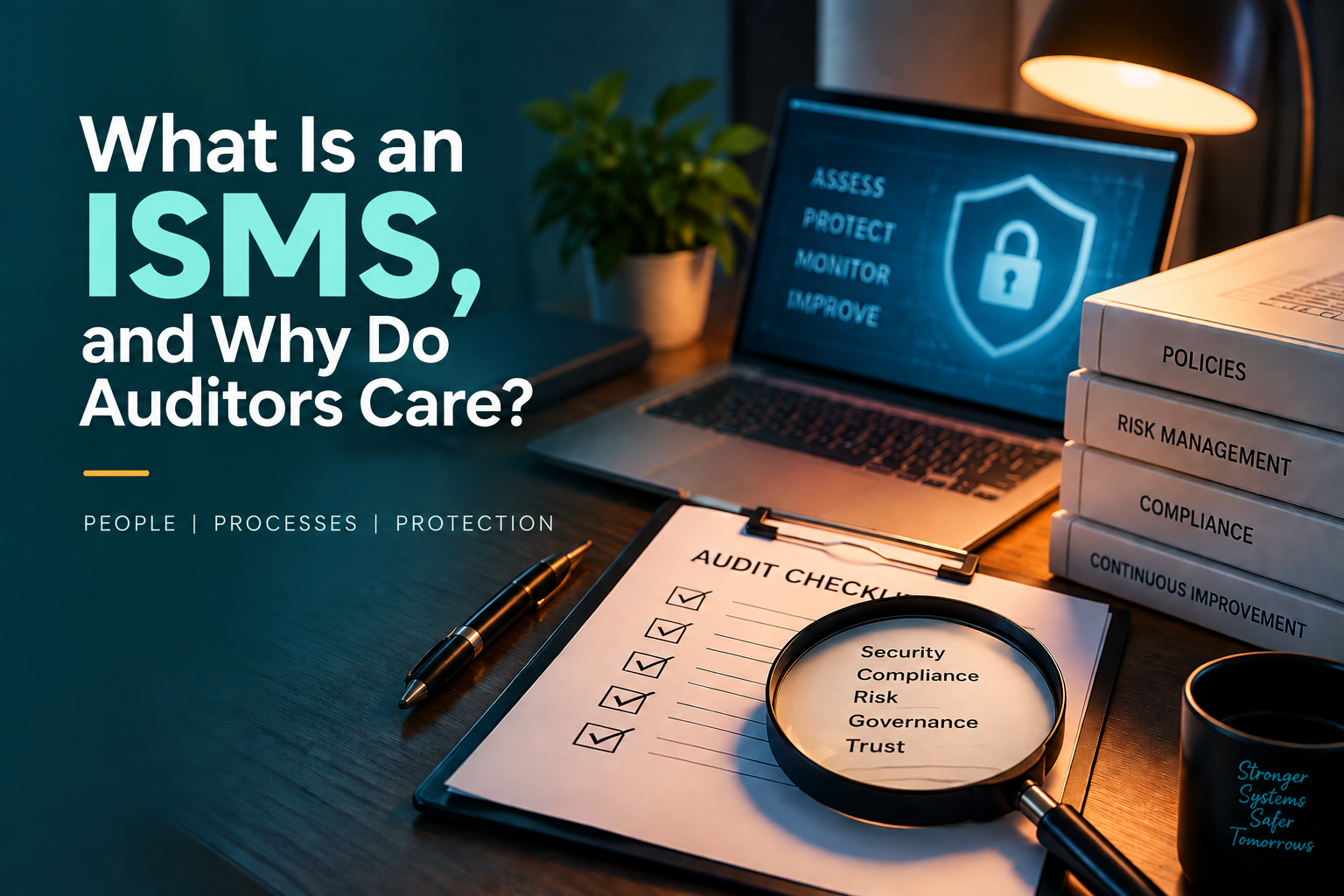
What Is an ISMS, and Why Do Auditors Care?
Published
September 17, 2026

If your company is getting ready for ISO 27001, you have probably heard the term ISMS more than once. But what exactly is an ISMS, and why does it matter to auditors?
An ISMS is more than a collection of information security policies. It is the management system your organization uses to identify information security risks, decide how to address them, assign responsibility, monitor whether controls work, and continually improve.
For SaaS and technology companies, this distinction is critical. Auditors want tosee that your information security program works and delivers on its promises.
This article explains the ISMS definition, why auditors care, and what the evidence looks like in practice.
An ISMS(information security management system) is a system of policies,processes, people, roles, and controls used to establish and maintain information security management throughout the organization. ISO 27001 evaluates whether the management system is established, implemented,maintained, and continually improved, based on objective evidence.
Think of an ISMS as the operating system that runs your information security program.
It connects decisions that might otherwise exist in separate places:
● What information and systems does the business need to protect?
● What are the most important risks?
● Which risks matter most?
● What controls are needed to reduce those risks?
● Who owns each control?
● How is performance measured?
● What happens when something does not work?
● How does leadership know whether the system remains effective?
That last question is particularly important.
A company can have excellent technical security tools and still have a weak ISMS.Conversely, an ISMS isn't necessarily strong just because it contains dozens of well-written policies.
The difference is how the system works in practice.
ISO/IEC27001 is the international standard for establishing, implementing,maintaining, and continually improving an information security management system.
The standard’s management-system requirements are specified in Clauses 4–10, which include:
Annex A provides a reference set of information security controls that organizations can consider when treating their risks.
This distinction is important: ISO 27001 certification is not simply acertification of individual security controls. It assesses whether your organization has an effective information security management system.
That is why auditors care about the connections between your scope, risks, controls,responsibilities, monitoring, and improvement.
An auditor needs evidence that your information security management systemactually operates. A readiness evaluation can help identify these gaps before the certification audit.
A policy can say employees must complete security awareness training. That doesnot prove employees completed it.
A risk register can identify vendor risk. That does not prove you perform vendorassessments.
A corrective action procedure can explain how you handle issues. That does not prove your organization actually identifies, assigns, tracks, and closes corrective actions.
Auditors therefore look for a trail between what your ISMS says and what yourorganization does.
During the Stage 1 audit, the certification body primarily evaluates your management system's readiness and documentation.
The auditor can review things like:
● ISMS scope
● Information security policies
● Organizational context
● Risk assessment methodology
● Risk assessment results
● Risk treatment approach
● Statement of Applicability(SoA)
● Information securityobjectives
● Internal audit arrangements
● Management reviewarrangements
● Other required documented information.
Stage1 is essentially asking: "Does an appropriate management system exist, and is the organization ready for thenext stage?"
A documentation problem can therefore become a readiness problem.
Stage 2 goes further.
The auditor evaluates whether the ISMS has actually been implemented and is operating effectively.
This is where any gap between your documentation and real operations will show up.
An auditor might follow a series of links:
Risk→ treatment → control → owner → evidence → monitoring → improvement
For example, when reviewing your risk assessment, you may identify a significant risk of unauthorized access to information.
The auditor may want to understand:
● How was the risk assessed?
● Who owns it?
● What treatment was selected?
● Which controls address it?
● What does your access-control policy require?
● How is access provisioned?
● Who reviews privileged access?
● When was the last review?
● What happened when an exception was discovered?
● Was the issue tracked and corrected?
That is the ISMS in action.
The auditor wants to see how your system works, not just a perfect set of folders.
This is one of the most important concepts for companies approaching certification.
An auditor does not necessarily expect your organization to be flawless.
They expect a controlled, repeatable system to identify problems, manage risks,evaluate performance, and improve where necessary.
That's very different from trying to create documentation that looks perfect on auditday.
A practical way to understand an ISMS is to reduce it to four fundamentalquestions.
Your organization needs to understand the information, systems, people, processes,and other assets relevant to information security.
Depending on your business, this could include:
● Customer data
● Source code
● Production infrastructure
● Cloud environments
● Employee information
● Intellectual property
● SaaS applications
● End points
● Business-critical processes
● Third-party services
The auditor may not look for a single spreadsheet containing everything, but theywill want your organization to know what the ISMS scope includes and what needs protection.
Potential evidence:inventories of assets, system inventories, data-flow documentation,architecture diagrams, application inventories, ownership records.
This is where risk management comes in.
Your organization needs a defined process to identify and evaluate information security risks.
That means determining:
● What threats or vulnerabilities exist?
● What could happen?
● How likely is it?
● What would the impact be?
● Which risks require treatment?
● Who owns the risk?
Potential evidence:risk methodology, risk register, risk assessments, risk owners, treatmentdecisions, review records.
Once the organization understands the risks, it decides how to address them.
Risk treatment could involve:
● Implementing security controls
● Changing a process
● Transferring risk
● Avoiding an activity
● Accepting a risk within defined parameters
The controls selected should make sense in relation to the organization's risks andrequirements.
Potential evidence:Statement of Applicability, policies, procedures, access reviews, securityconfigurations, vendor assessments, training records, incident records,technical reports.
This is where third-party risk comes in. When suppliers access sensitive informationor critical systems, the organization must factor supplier security into itsrisk management approach.
This question separates a static compliance program from a functioning management system.
Your organization needs ways to evaluate whether the ISMS is performing as intended.
That can include:
● Security metrics
● Internal audits
● Management reviews
● Control testing
● Incident analysis
● Nonconformity tracking
● Corrective actions
● Risk reviews
● Security objectives andperformance measurements
Potential evidence:KPI reports, internal audit reports, management review minutes,corrective-action records, meeting records, monitoring results, and improvementplans.
If your ISMS cannot provide this evidence, including dates, owners, and outcomes,auditors will assume the system exists only on paper.
One of the most common ISMS problems is the documentation-versus-reality gap.
The company has the documents. The documents look professional. But the processes they describe aren't consistently happening.
Here is the difference:
Pile of Policies Working ISMS
Policies created for certification Policies used to guide actual operations
Risk register created once Risks reviewed and updated
Controls listed without clear ownership Controls have accountable owners
Internal audit treated as a formality Internal audit identifies meaningful issues
Management review is a meeting on paper Leadership reviews performance and makes decisions
Exceptions disappear into email Issues are documented and tracked
Evidence collected at the last minute Evidence is generated naturally through operations
Corrective actions are vague Actions have owners, deadlines, and closure evidence
A risk register from six or twelve months ago may no longer reflect the organization.
Consider a SaaS company that has:
● launched a new productionenvironment,
● changed cloud providers,
● introduced AIfunctionality,
● added new subprocessors,
● entered a new market, or
● significantly changed itsworkforce.
If none of that is reflected in the organization's risk thinking, an auditor mayquestion whether the risk-management process is actually functioning.
Internal audits are not just another box to check.
They are one mechanism an organization uses to evaluate its ISMS before an externalauditor does.
If internal audits are incomplete, superficial, or missing entirely, leadership loses an important opportunity to identify problems before certification.
A beautifully written access-control policy does not help if you don't performaccess reviews as required.
The same principle applies to:
● Security awareness
● Incident management
● Supplier assessments
● Change management
● Backup procedures
● Risk reviews
● Asset management
The auditor may compare your documented requirements with operational evidence.
If your documentation and real operations don't match, your paperwork can workagainst you in an audit.
A strong ISMS isn't about piles of documentation.
An effective ISMS delivers on its promises—and the organization can demonstrate itwith objective evidence. It means you can show a system with current,traceable, and clear evidence.
Before an ISO 27001 audit, your evidence set should typically include items such as:
Can you clearly explain:
● What entities are included?
● Which products or servicesare covered?
● Which locations andprocesses are included?
● What boundaries andinterfaces exist?
Can you demonstrate that you identified and evaluated information security risksusing a defined methodology?
Can you show how you addressed the significant risks and who is responsible forthem?
Can you explain which Annex A controls are applicable, which are not, and why?
Can you demonstrate that the ISMS has undergone an internal evaluation?
More importantly, can you show what the organization did with the findings?
Can leadership demonstrate that it reviewed the performance and suitability of the ISMS and made decisions where needed?
Strong audit preparation and validationcan help confirm that your evidence is complete and traceable before the external audit.
When something goes wrong, can you demonstrate:
Issue→ root cause → corrective action → owner → completion → verification
That is the improvement loop auditors want to see.
At BrightLine, we advise organizationson how to design and implement an ISMS, which typically takes 8-12 weeks toreach readiness for an ISO 27001 certification audit. Our approach focuses on creating a system that stands up to real scrutiny, not just a documentation pack.
It's not necessarily true.
ISO27001:2022 Annex A contains 93 controls, but you determine applicability through your risk-management process and organizational context.
You do not need to implement every control just because it is listed in Annex A.
The goal is to identify and treat your information security risks appropriately and document the resulting decisions.
No.
Certification does not eliminate cyber risk.
It shows that an organization has an information security management system inplace that meets the standard's requirements.
Security threats continue to evolve. A trustworthy ISMS is designed to help anorganization manage that changing risk—not promise that incidents will never happen.
An ISMS is an organizational management system, not simply an IT initiative.
IT and security teams may operate many of the controls, but effective information security also involves:
● Leadership
● HR
● Legal
● Procurement
● Engineering
● Operations
● Finance
● Employees
● Third parties
That is why leadership involvement is fundamental.
For organizations without a large internal security leadership team, a vCISO forISMS can provide governance, accountability, and strategic direction while internal teams keep the business running.
Certificationis not the finish line.
Your ISMS needs to remain operational, monitored, reviewed, and improved.
Risks change. Employees change. Vendors change. Products change. Regulations change.Technology changes.
Your management system needs to change with them.
The strongest ISMS programs don't start with: "What documents do we need for the auditor?"
They start with: "What risks does our business actually face, and how do we know we're managing them?"
The documentation and evidence should then follow from that operating model.
For a growing SaaS company, that approach has another advantage: it helps close the gap between compliance readiness and actual security operations.
If you're preparing for ISO 27001 or responding to enterprise customer security requirements, BrightLine can help you build that system around your actual business—not around a generic compliance checklist.
Our readiness approach helps organizations identify gaps, establish the necessary management processes, organize evidence, and prepare for certification with a practical timeline.
Geta Free ISMS Readiness Assessment
Schedule a 30-minute consultation to discuss your current compliance status, target certification, existing security program, andtimeline. You can also explore BrightLine's vCISO leadership support if your organization needs experienced security leadership to build and operate theISMS.
Your goal shouldn't be to survive an audit. It should be to build an ISMS that keeps working after the auditor leaves.