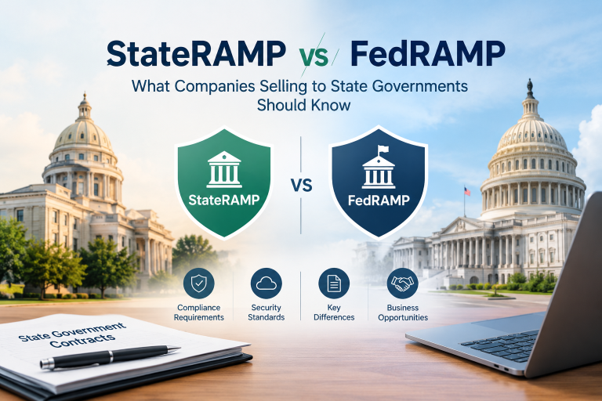
StateRAMP vs FedRAMP: What Companies Selling to State Governments Should Know
Published
November 2, 2026

SellingSaaS or cloud services to government sounds straightforward—until a buyer asks,“What is your RAMP status?”
For a growing GovTech company, choosing between StateRAMP vs. FedRAMP can affect your sales pipeline, compliance budget, implementation timeline, and ability to enter new government markets. In 2026, another detail to understand:StateRAMP now operates under the name GovRAMP.
The right path is not necessarily the most expensive certification. It is the one that fits where you sell, what data you handle, what government buyers require,and where you intend to go next.
Here is how to evaluate the decision.
The simplest way to understand the difference is this:
FedRAMP is designed for federal government cloud procurement. GovRAMP (formerly StateRAMP) is designed for state, local, tribal, and educational government environments.
Both programs are built around rigorous security controls and third-party assessment, but they serve different government markets.
FedRAMP GovRAMP (formerly StateRAMP)
Primary market U.S. federal agencies State, local, tribal & education
Program focus Federal cloud security authorization Public-sector cloud security verification
Security foundation NIST-based federal requirements NIST 800-53-based requirements
Assessment Independent assessment 3PAO assessment for key verification levels
Impact levels Includes Low, Moderate and High paths Low, Moderate and High
Best fit Companies targeting federal contracts Companies targeting state/local markets
Reciprocity Can support certain state programs Can support participating government programs
The important point is that one does not automatically replace the other.
A company that sells mainly to state governments should not conclude it requires FedRAMP just because its offering is cloud-based. On the other hand, a company that's pursuing federal contracts shouldn't assume that GovRAMP will satisfy federal procurement requirements.
The buyer and contract requirements ultimately determine what you need.
If you look up StateRAMP certification these days, you will more and more often come across the name GovRAMP.
StateRAMP announced the rebrand to GovRAMP on February 14, 2025. The organization says the change reflects a broader focus on state, local, tribal, and educational governments, not just state governments. Although the legal entity remains StateRAMP, it does business as GovRAMP.
So,when someone asks about:
● StateRAMP certification
● StateRAMP compliance
● StateRAMP requirements
● StateRAMP vs FedRAMP
● GovRAMP vs FedRAMP
They generally refer to the same program lineage, although GovRAMP is the current operating name.
That distinction matters for SEO—but more importantly, when evaluating current program documentation and procurement requirements.
The biggest mistake is treating this as a simple “which certification is better?”question.
It is really a market strategy question.
FedRAMP provides a standardized approach for assessing and authorizing cloud services for federal government use.
In 2026, FedRAMP is also undergoing a significant modernization through FedRAMP20x. The new model emphasizes measurable security outcomes, automation,reusable evidence and continuous assurance rather than relying solely on traditional documentation-heavy processes.
The 2026 Consolidated Rules are now in effect as the foundation for the new approach, with mandatory adoption milestones beginning in 2027.
GovRAMP provides a standardized approach for cloud providers serving public-sector organizations.
Its current program includes Low, Moderate and High impact levels, along with multiple verification stages. Ready, Provisionally Authorized, and Authorized statuses require independent assessment by an approved Third-Party Assessment Organization (3PAO), while Core offers an earlier verification pathway.
The program is based on NIST 800-53 security controls and provides standardized documentation and assessment resources for providers.
Here is the practical question:
Who are you trying to sell to?
If your pipeline is dominated by federal agencies, FedRAMP belongs on your roadmap.
If your customers are primarily state agencies, municipalities, school systems or other participating public-sector organizations, GovRAMP may be the more directly relevant starting point.
FedRAMP can still be strategically valuable for a state-focused company, particularly if federal expansion is part of your near-term growth plan. But pursuing federal authorization solely because it sounds more prestigious can create unnecessary cost, complexity and delay.
A better decision process is:
Compliance should support your salesstrategy—not dictate it without a business reason.
For a startup or mid-market SaaS company with a state-heavy sales pipeline, a GovRAMP-first strategy can make sense.
Suppose your company has:
● 20–100 employees
● A limited compliance budget
● Several state government prospects
● No immediate federal pipeline
● A mature but still developing security program
Going directly after federal authorization may consume resources that could otherwise support product development, sales and customer onboarding.
A more practical approach may be to build the security foundation, pursue theGovRAMP status your target buyers require, establish government references, and then evaluate FedRAMP when federal demand justifies the investment.
This is not about choosing the “easier” certification.
It is about choosing the certification that creates the clearest path to revenue.
And GovRAMP is not simply a paperwork exercise. Its current Ready pathway requires documentation, continuous monitoring information, a POA&M (where applicable), and independent assessment by a 3PAO.
This is where the StateRAMP vs FedRAMP comparison becomes more nuanced.
There is no universal rule saying:
“Get one RAMP certification and every government accepts it.”
Government procurement requirements can differ by state, agency, and contract.
Some programs provide reciprocity or streamlined pathways, while others may require additional review.
Texas is a particularly useful example.
TX-RAMP recognizes GovRAMP and FedRAMP status through a reciprocity process. However,as of October 30, 2024, TX-RAMP no longer automatically adds FedRAMP- and StateRAMP-certified products to its certified products list. Vendors must submit a reciprocity request, and TX-RAMP validates the applicable certification level before issuing reciprocal certification.
So the lesson is simple:
Reciprocity can reduce duplication, but it does not mean “no action required.”
Always verify the current requirements of the specific government buyer.
Texas deserves special attention if it is part of your sales strategy.
TX-RAMP was created to help Texas government entities evaluate the security of cloud computing services. Texas also provides a reciprocity mechanism for qualifying GovRAMP and FedRAMP stat uses.
GovRAMP currently reports participation from government and education organizations nationwide, reflecting a broader public-sector shift toward standardized cloud security verification.
But don't assume “GovRAMP = accepted everywhere.”
Individual states can establish their own requirements.
For example, Arizona’s program accepts GovRAMP or FedRAMP and does not treat TX-RAMP, SOC 2, or ISO 27001 as substitutes for its required framework.
Your certification roadmap should therefore start with a target-state procurement map, not a generic checklist.
Cost is one of the first questions leadership teams ask.
The problem is that neither program has a reliable single price tag.
Your total investment depends on factors such as:
● Current security maturity
● Product scope
● Impact level
● Number of controls requiring remediation
● Assessment requirements
● 3PAO fees
● Documentation maturity
● Cloud architecture
● Continuous monitoring
● Internal compliance resources
This is why broad online estimates can be misleading.
Instead of asking, “How much does FedRAMP cost?”, ask:
“How far are we from the security and evidence requirements our target buyers expect?”
The same principle applies to GovRAMP.
GovRAMP’s current verification structure lets companies progress through different stages, including Snapshot, Core, Ready, and Authorized pathways. This provides a more structured way to build maturity, rather than treating compliance as one giant project.
For a growing SaaS company, readiness work should therefore focus first on identifying the gaps that could delay assessment—not simply collecting templates.
This is where experienced security guidance matters.
A polished folder of policies does not automatically mean your company is ready for a government assessment.
You need evidence that security controls actually operate.
That can include:
● Access controls
● Asset management
● Vulnerability management
● Incident response
● Logging and monitoring
● Risk management
● Secure configuration
● Change management
● Business continuity
● Vendor management
● Continuous monitoring
FedRAMP20x reinforces this shift toward demonstrating measurable security outcomes.Its 2026 framework introduces concepts such as a continuously maintained Security Decision Record to document security decisions throughout the cloud servicelifecycle.
Thatis an important signal for every GovTech company:
Readiness increasingly means proving how security works—not just that policies exist.
The biggest compliance mistake is starting with a framework before understanding the business requirement.
BrightLine Readiness takes a readiness-firstapproach: understand your market, identify the required framework and impactlevel, assess your current security posture, and build a realistic roadmap toclose the gaps.
For companies considering federal requirements, FedRAMP Advisory can help translate the federal compliance path into an actionable strategy.
If your organization also needs a strong commercial security foundation, SOC 2 Type I & II may be part of the broader roadmap.
The goal is not to collect certifications.
The goal is to build a security program that can withstand scrutiny from customers,assessors, and government buyers.
Choose GovRAMP first when your immediate revenue opportunity is primarily with state, local, tribal, or education buyers and their procurement requirements align with GovRAMP.
Prioritize FedRAMP when federal agencies are central to your growth strategy or your target contracts specifically require federal authorization.
Consider both when you are building a multi-market government sales strategy and have the resources to support the additional requirements.
And if you’re unsure, don’t start by buying another compliance template.
Start by mapping your buyers, data, impact level, current controls, certification gaps, and sales timeline.
That is how you avoid spending months and significant budget on the wrong path.
1.Is StateRAMP still called StateRAMP?
The organization rebranded as GovRAMP in February 2025, although StateRAMPremains the legal entity name.
2.Is GovRAMP the same as FedRAMP?
No.They serve different government markets, although their security approaches have important similarities.
3.Does GovRAMP automatically satisfy federal requirements?
No.Federal agencies must evaluate FedRAMP requirements separately.
4.Is SOC 2 a replacement for GovRAMP or FedRAMP?
Generally,no. SOC 2 can strengthen your security program, but government procurement requirements may require a specific RAMP framework.
5.How should I choose between GovRAMP and FedRAMP?
Start with your target buyers and their procurement requirements. Then evaluate your data sensitivity, impact level, current security maturity, budget, and federal/state growth plans.
The right certification strategy should get you closer to your next government customer—not simply give you another badge to put on your website.
Schedule a 30-minute conversation to map out your certification goals.BrightLine can help you understand where you are today, what your target buyers require, and which readiness path makes business sense.
Build security on what is true—not on templates.